JKR Approval: Future of Malaysia's Infrastructure
Infrastructure, JKR Approval, EcoPatch
What JKR Approval Means for the Future of Malaysia’s Infrastructure
The official approval of EcoPatch by Jabatan Kerja Raya (JKR) is more than a product milestone; it is a signal of where Malaysia’s infrastructure is heading—towards safer, greener, and more resilient national assets backed by rigorous engineering standards.

JKR-Approved Innovation for Stronger Roads
EcoPatch sets a new benchmark for compliant, high-performance pavement repair
Why JKR Approval Carries Strategic Weight for Businesses and Agencies
As Malaysia’s central technical authority for public works, JKR oversees more than 2,400 physical construction projects worth over RM133 billion nationwide, alongside thousands of maintenance and rehabilitation works annually (KKR, 2026). When this institution formally approves a material like EcoPatch All‑Weather Cold Mix, it effectively grants a passport into federal, state, and municipal projects that must comply with JKR’s standards.
For ministries, local authorities, concessionaires, and engineering consultants, JKR approval simplifies due diligence. Instead of individually stress‑testing every new solution, agencies can rely on JKR’s established vetting processes, which are grounded in technical manuals, standard specifications, and performance benchmarks refined over decades. In this environment, an approved product is not just “allowed”—it is trusted.
The Rigorous Standards Behind JKR Certification
JKR’s endorsement is rooted in a comprehensive framework of guidelines and specifications. For building works, the Standard Specification for Building Works JKR 2020 sets tight requirements on materials, workmanship, and compliance with Malaysian Standards (MS) or recognised international equivalents. For road works, specifications such as JKR 20500‑0048‑17 prescribe approved materials, performance thresholds, and installation methods to ensure consistency and durability across the national network (JKR / KKR, 2020–2024).
Recent initiatives underscore how demanding this framework has become. New design and installation guidelines for EV charging systems, updated mechanical system manuals, and strict traffic management plan (TMP) requirements all point to a department that prioritises safety, maintainability, and long‑term lifecycle performance over short‑term cost savings. Contractors themselves are now vetted more tightly on technical capacity, governance, and past performance before being entrusted with public funds.
For a pavement repair solution like EcoPatch to pass through this filter, it must demonstrate:
Material reliability – consistent performance that aligns with road and building specifications, including skid resistance and structural integrity in real‑world conditions.
Safety and usability – safe installation procedures, compatibility with TMP requirements, and rapid return to service to minimise traffic disruption.
Sustainability and maintainability – eco‑friendly, non‑toxic composition, minimal waste, and long shelf life that support JKR’s move towards greener, more maintainable infrastructure.
EcoPatch: A High‑Performance Solution Aligned with National Priorities
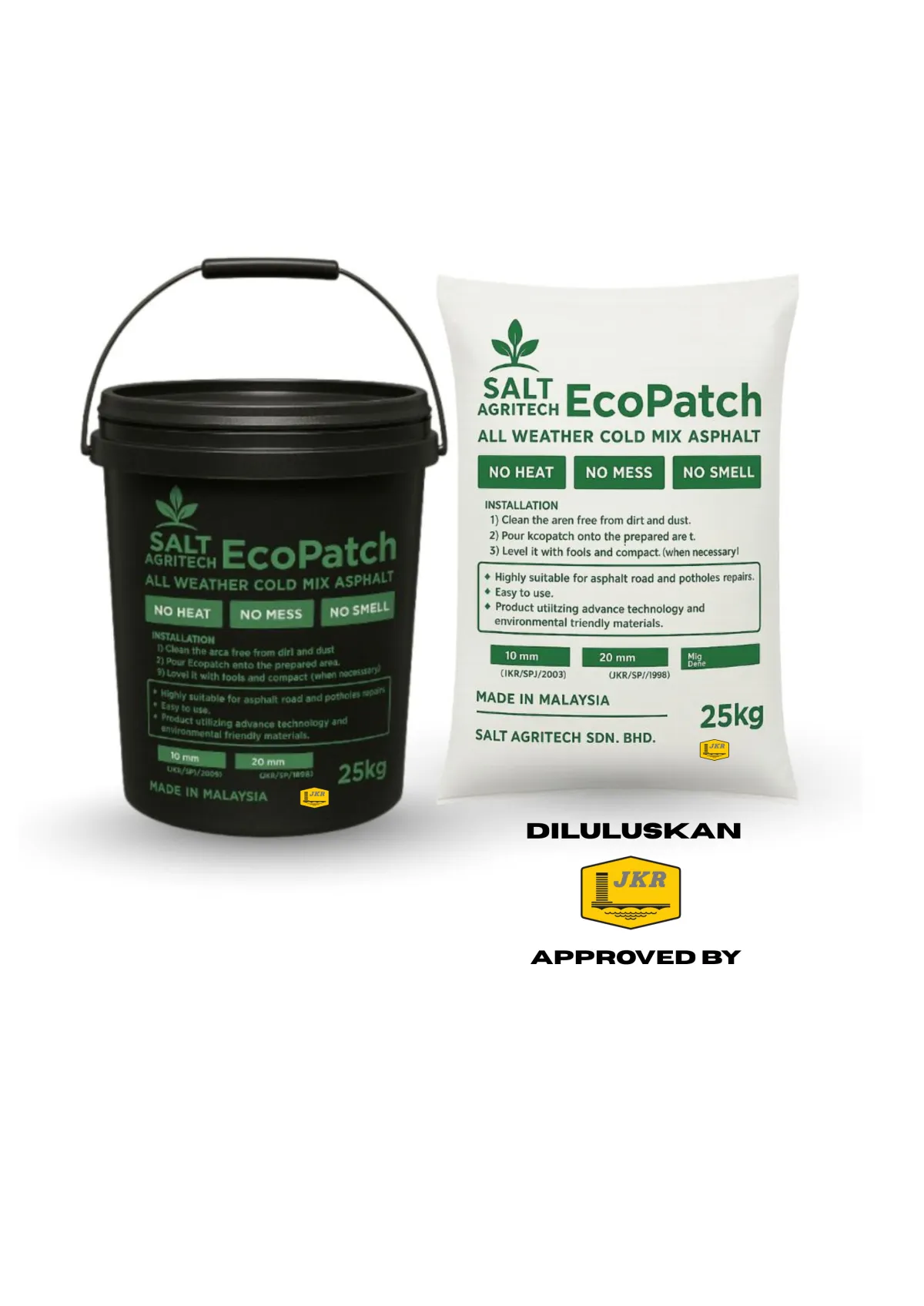
EcoPatch’s JKR approval confirms that it meets these expectations. Designed as an all‑weather cold‑mix repair material, EcoPatch delivers high skid‑resistance and dependable performance in Malaysia’s challenging tropical climate—whether under intense heat or heavy monsoon rainfall (Saltagritech, 2026). Because it requires no heating, tack coat, or primer, agencies can deploy it quickly using lightweight tools, reopening repaired sections to traffic almost immediately. This is particularly valuable on busy federal roads and urban corridors where lane closures directly affect economic activity.
Its environmental profile—eco‑friendly, non‑toxic, with minimal material waste and strong shelf life—supports broader government commitments to sustainability. With thousands of kilometres of roads and bridges delivered under the 12th and 13th Malaysia Plans, scalable, low‑impact maintenance solutions like EcoPatch will be essential to keeping assets in service without escalating lifecycle costs.

Fast, all-weather EcoPatch repairs help agencies cut downtime and maintenance backlogs.
Building Authority and Reducing Risk for Decision‑Makers
For businesses and agencies, adopting a JKR‑approved solution like EcoPatch is a strategic way to reduce technical and governance risk. The product has already been scrutinised against the same standards that govern national road geometry, TMPs, and building specifications. This helps project owners demonstrate compliance, defend procurement decisions, and avoid the reputational and financial cost of premature failures or non‑conforming works.
As Malaysia accelerates investment across roads, schools, health facilities, and digital infrastructure, EcoPatch’s JKR approval positions it as a trusted, high‑performance option for nationwide deployment. For agencies tasked with delivering safe, durable, and sustainable infrastructure at scale, it offers something increasingly rare: innovation that is already aligned with the country’s most authoritative technical standards.